Comparison of Harm Across Different Tobacco Products: Cigarettes, Cigars, Pipe Tobacco, Snuff, E-cigarettes, Heated Tobacco
No tobacco product is safe. This is the basic consensus in public health. But "none are safe" does not equal "all are equally harmful." Different products differ significantly in whether they burn, how nicotine enters the bloodstream, the types and doses of Harmful and Potentially Harmful Constituents (HPHCs), and usage patterns, thus presenting a gradient often called the continuum of risk: Overall, combusted tobacco products (especially frequently deeply inhaled manufactured cigarettes) carry the highest risk; complete non-use of tobacco and non-medical nicotine products carries the lowest risk; in between lie various non-combusted or reduced-combustion delivery methods — their relative positions vary significantly by product type, intensity of use, and dual use with cigarettes.
This article systematically compares six common product categories — cigarettes, cigars, pipe tobacco, snuff, e-cigarettes, heated tobacco — along three main lines: nicotine absorption, harmful substance exposure, and differences in usage patterns, helping readers establish a verifiable relative risk framework, rather than endorsing any commercial "harm reduction" narrative.
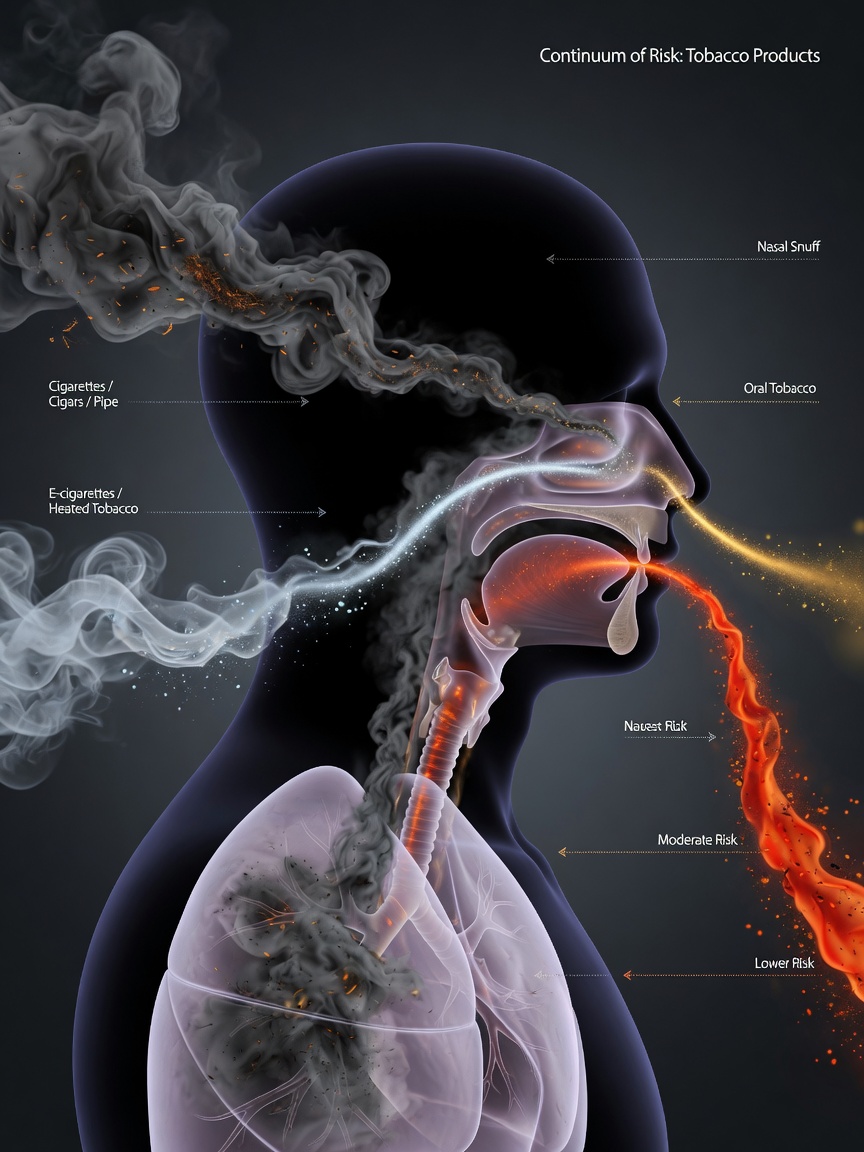
I. Establishing a Comparison Framework: What to Compare and What Not
1. Relative Risk vs. Absolute Safety
2. Evidence Hierarchy (A "Credibility Scale" for Reading the Rest)
| Evidence Level | Content | Persuasive Power | Limitation |
|---|---|---|---|
| Chemical analysis | HPHCs in smoke/aerosol/extracts | High (composition & dose) | Does not equal human disease |
| Exposure biomarkers | Urine/blood nicotine metabolites, TSNA metabolites, CO, etc. | Medium-High | Short-term, affected by behavior |
| Short-term functional/clinical | Blood pressure, airway inflammation markers, mucosal changes, etc. | Medium | Endpoints mostly intermediate |
| Long-term disease outcomes | Lung cancer, COPD, myocardial infarction, all-cause mortality, etc. | Highest (if well-designed) | Follow-up on newer products still insufficient |
Newer products (e-cigarettes, heated tobacco) have fewer long-term hard endpoint studies than cigarettes and traditional smokeless tobacco; the text will indicate that "lower exposure" and "lower disease" cannot be automatically equated.
3. Overview of Six Product Categories
| Product | Core Principle | Typical Combustion | Main Entry Route |
|---|---|---|---|
| Cigarettes | Tobacco shreds burned at high temperature, smoke repeatedly inhaled | Yes | Mouth → entire respiratory tract → primarily alveoli |
| Cigars | Wrapped tobacco product burned | Yes | Primarily oropharynx; some deep inhale |
| Pipe tobacco | Tobacco burned in a pipe | Yes | Primarily oropharynx; habits vary widely |
| Snuff | Tobacco powder/preparation, not typical "smoking combustion inhalation" | Generally no | Dry snuff: nasal mucosa; moist snuff: oral mucosa |
| E-cigarettes | Heating e-liquid to produce aerosol | No | Mouth → respiratory tract → lungs |
| Heated Tobacco (HTP/HNB) | Heating tobacco substrate to avoid full combustion | No (incomplete combustion) | Mouth → respiratory tract → lungs |
II. How Usage Patterns Rewrite Risk
Chemical composition determines "what could harm"; usage pattern determines "to what extent and where the actual harm occurs."
1. Cigarettes: High-Frequency, Deep Inhalation, Standardized Addiction Machine
2. Cigars: Large Volume, Alkaline Smoke, Divided Inhalation Habits
3. Pipe Tobacco: Slower Pace, but Oral Local Effects and Sidestream Smoke Are Prominent
4. Snuff: Route Completely Rewritten — Lungs May Not Be the Main Battlefield, But Nasal/Oral and Systemic Still Are
First, distinguish categories to avoid conflating under the single term "snuff":
| Type | Usage | Main Target Organ (Local) | Systemic Exposure |
|---|---|---|---|
| Dry snuff | Nasal inhalation/sniffing of powder | Nasal-nasopharyngeal mucosa | Nicotine absorption through nasal mucosa + swallowable secretions |
| Moist snuff / oral snuff, some snus | Placed between lip and gum | Oral mucosa, gums | Rapid nicotine absorption through oral mucosa |
5. E-cigarettes: No Combustion, But Not "Water Vapor"
6. Heated Tobacco: Still Tobacco, Just "Heated Rather Than Fully Combusted"
III. Nicotine Absorption: The Same "Addictive Substance," Different Entry Points
Nicotine itself is not tar, but it is the core reinforcer maintaining use behavior, and is associated with increased blood pressure and heart rate, vascular endothelial function, and risks in pregnancy and adolescent brain development. When comparing harm, one cannot compare only "toxicity" but also "whether it makes you unable to stop."
1. Absorption Site and Speed (Relative Relationships)
| Product | Main Absorption Site | Peak Characteristics (Qualitative) | Addiction Maintenance Key Points |
|---|---|---|---|
| Cigarettes | Alveolar capillaries (primarily) | Extremely fast; arterial nicotine rises rapidly after one puff | Strong "one puff, one reward" reinforcement |
| Cigars | Oral mucosa primarily; lungs if inhaled | Can obtain nicotine without relying on deep inhalation | Large single dose of tobacco can make per-exposure very high |
| Pipe | Oral mucosa primarily; lungs if inhaled | Often slower pace | Behavioral ritual + nicotine |
| Dry snuff | Nasal mucosa (+ gastrointestinal after swallowing) | Can be relatively fast via nasal route | Dual binding of local irritation and nicotine |
| Moist snuff/oral | Oral mucosa | Sustained release | Can be held all day; troughs smoothed but total exposure high |
| E-cigarettes | Respiratory tract/lungs primarily | Determined by device and puffing behavior; can approach cigarettes | High-nicotine salt formulations can rapidly satisfy |
| Heated tobacco | Respiratory tract/lungs primarily | Often designed to match cigarette satisfaction | Nicotine dependence easily maintained after switching |
2. Key Variables Affecting Absorption
3. Comparison with Medicinal NRT (For Orientation)
Nicotine patches, gum, lozenges, nasal sprays, etc., NRTs are characterized by controlled doses, no combustion, no tobacco matrix, and use as a smoking cessation treatment tool. Conflating e-cigarettes/heated tobacco/snuff with NRT under "it's all nicotine" obscures the essential differences: presence or absence of tobacco-specific toxins, approval as a medicine, and whether the goal is cessation or maintenance of pleasure.
IV. Harmful Substance Exposure: Combustion Is the Great Divide
1. The "Classic Toxin Package" of Combusted Tobacco
As long as high-temperature combustion occurs in cigarettes, cigars, and pipe tobacco, they share a broadly similar problem list (dose and proportion vary by product):
2. Non-Combusted Pathways: A Changed Problem Set, Not Problem Absence
| Exposure Dimension | Cigarettes (Reference) | Cigars/Pipe | Snuff (Non-combusted) | E-cigarettes | Heated Tobacco |
|---|---|---|---|---|---|
| Combustion particles/tar-related | Very high | High (depends on total amount and habits) | Very low/no typical combustion smoke | Extremely low (combustion tar by definition) | Significantly lower than cigarettes, not zero |
| CO | High | Medium-High (depends on inhalation) | Typically very low | Typically very low | Typically lower than cigarettes |
| TSNAs etc. tobacco-specific | High | Present | Present (leached/local) | Generally far lower than tobacco combustion; depends on contamination and e-liquid | Present, often lower than cigarette smoke |
| Carbonyls/irritant VOCs | High | Present | Route different | Can be present (generated by heating e-liquid) | Can be present |
| Flavorings and additives-related | Present | Present | Present (includes flavored snuff) | **Prominent** (flavor-driven) | Present (tobacco + possible processing) |
| Metals | Present | Present | Possible | Heating element-related traces | Device and tobacco-related |
| Secondhand exposure form | Smoke | Smoke | Dust/odor/expelled material | Aerosol | Aerosol |
3. How to Correctly Read "Lower Exposure"
Regulatory and independent reviews often emphasize:
V. Major Health Outcomes: Route-by-Route Comparison (Evidence Strength Indicated)
The following are directional comparisons, not individual predictions. Individual risk also depends on years of use, daily quantity, age of initiation, genetics, comorbidities, and whether cessation has occurred.
1. Lung Cancer and Lower Respiratory Chronic Disease
| Product | Relative Logic | Evidence Impression |
|---|---|---|
| Cigarettes | Among the strongest behavioral risk factors for lung cancer and COPD | Very strong, long-term population evidence |
| Cigars/Pipe | If regularly inhaled, lung risk increases; even without inhalation, still non-zero; heavy inhalers in the general population have high risk | Strong (traditional tobacco epidemiology) |
| Snuff | Combustion-related lung cancer pathway weak; cannot claim "no cancer risk" | Medium (large variation by region and product) |
| E-cigarettes | Different toxin profile; long-term lung cancer/COPD hard endpoints insufficient | Medium for exposure evidence, insufficient for long-term outcomes |
| Heated tobacco | Many HPHCs lower than cigarettes; long-term cancer endpoints insufficient | Same as above |
2. Oral Cavity, Throat, Esophagus, and Nasal Local Effects
3. Cardiovascular
4. Addiction, Mental/Behavioral Health, and Life Course
5. Secondhand and Thirdhand Exposure
VI. Comprehensive Comparison Table
| Product | Combustion | Nicotine Delivery | Overall Toxin Exposure Trend vs. Cigarettes | vs. Complete Non-Use | Typical Residual/Characteristic Risks | Evidence Notes |
|---|---|---|---|---|---|---|
| Cigarettes | Yes | Extremely fast, strong lung absorption | Reference high | One of the highest risk tiers | Lung cancer, COPD, cardiovascular, multiple cancers, secondhand smoke | Most abundant long-term endpoint evidence |
| Cigars | Yes | Oral mucosa ± lungs, can be very high | Often still high; depends on inhalation and amount | Clearly harmful | Oral/upper digestive, cardiovascular; lung risk if inhaled | "Not inhaling" severely misunderstood |
| Pipe | Yes | Oral mucosa ± lungs | Often lower than heavy cigarette smokers, but can still be high | Clearly harmful | Oral local effects, combustion toxins, sidestream smoke | High habit heterogeneity |
| Snuff (dry/moist) | No | Nasal or oral mucosa, sustained | Combustion-related lung exposure greatly reduced; tobacco toxins remain | Still harmful | Nasal or oral local lesions, addiction, cardiovascular; cancer spectrum differs from smoking | Must distinguish dry/moist and regional products |
| E-cigarettes | No | Can approach cigarettes | Many HPHCs often significantly lower than cigarettes | Still harmful | Airway irritation, unknown long-term outcomes, dual use, adolescent initiation | Extremely high product heterogeneity |
| Heated tobacco | Heat tobacco | Can match cigarette satisfaction | Many HPHCs often lower than cigarettes, higher than air | Still harmful | Residual risk from tobacco aerosol, addiction, evidence window still short | Cannot claim "smokeless = harmless" |
Reading guide for the table:
2. Into lungs, nose, or mouth — determines the local battlefield.
3. Does nicotine still make you use daily — determines exposure years.
4. Still smoking cigarettes or not — determines whether the "harm reduction accounting" is cooked.
VII. Clarification of Common Misconceptions
Misconception 1: "Smoking cigars/pipe doesn't count as smoking, so it's fine"
Combusting tobacco is a form of smoking behavior. Not deeply inhaling only reduces part of lung deposition, and does not eliminate oral cancer pathways, cardiovascular risk, nicotine addiction, or secondhand smoke.
Misconception 2: "Snuff doesn't go into the lungs, so it's safe"
Not entering the lungs mainly weakens the classic smoking-related lung injury pathway, not whole-body zero risk. The nasal or oral mucosa becomes a new high-intensity exposure surface, and nicotine and TSNAs can still enter the bloodstream.
Misconception 3: "E-cigarettes/heated tobacco = harmless vapor"
No open-flame combustion does not equal no harmful chemicals, no ultrafine particles, and no addiction. For current smokers, complete switching may reduce certain exposures; for never-smokers, use is additional risk; for dual users, benefits are often overestimated.
Misconception 4: "95% less harmful than cigarettes, so it's fine to use freely"
Expressions like "approximately 95% less harmful" come from specific public health assessment contexts, targeting rough order-of-magnitude discussions of adult smokers switching to specific products relative to continued smoking, and are subject to methodological controversy and conditional limitations. They must not be translated as "only 5% harmful, so adolescents or non-smokers can use it too" or "long-term safety has been proven."
Misconception 5: "Natural tobacco, no filter, handmade = healthier"
"Natural" is not a toxicology get-out-of-jail-free card. Combustion chemistry is determined by temperature and organic matter; lack of a filter or rough processing may even alter smoking behavior and exposure.
Misconception 6: "Switching products equals quitting smoking"
The optimal health endpoint for quitting is stopping all tobacco use and managing nicotine dependence within a medical framework (with NRT etc. if needed). Switching products is at most a risk reduction strategy discussion for some populations, and must be premised on complete substitution with no return to cigarettes, while accepting the reality that long-term evidence is still accumulating.
VIII. How to Use This Comparison in Personal Decision-Making (Popular Science Level)
2. If you currently smoke cigarettes: The priority pathway is evidence-based cessation (behavioral support + medication/NRT as needed). Discussion of e-cigarettes or heated tobacco should be understood within a public health framework of "complete substitution" and "preventing adolescent use," not as a cost-free snack.
3. If you use cigars, pipe, or snuff while reassuring yourself "I'm less harmful": Use this article's pathway thinking for self-check — do you already have oral/nasal symptoms? Are you actually inhaling somewhat? Is your daily nicotine still high? Is your family exposed to secondhand smoke?
4. If you dual use: Honestly record your weekly cigarette count and puffs of other products; many people who say "I've already switched to new products" have not actually reduced their total toxin and nicotine ledger.
5. If you experience hemoptysis, hoarseness lasting over two weeks, oral leukoplakia, progressive nasal obstruction with smell loss, chest pain, etc.: Seek medical attention promptly; do not replace diagnosis with product comparison articles.
IX. Summary
X. Verifiable Reference Directions (For Extended Reading)
When writing and verifying, priority can be given to searching the following types of publicly available materials and review threads (not relying on single commercial press releases):
2. UK public health bodies and the Royal College of Physicians (RCP), etc. assessment of e-cigarettes as a substitute for smokers, and subsequent updates with reservations.
3. Cochrane systematic reviews: randomized evidence and safety intermediate indicators for e-cigarettes used for smoking cessation.
4. WHO policy position papers on e-cigarettes and heated tobacco: emphasizing youth protection, vigilance against industry interference, and evidence gaps.
5. Exposure science literature: cigarette/cigar/pipe smoke chemistry; smokeless tobacco TSNAs; HPHC comparisons and biomarkers (NNAL, COHb, nicotine metabolites, etc.) for e-cigarettes and HTP.
6. Traditional epidemiology: cohort and case-control studies of cigars, pipe, oral tobacco and oral cancer, cardiovascular disease, all-cause mortality.
7. Snuff-specific: nasal pathology of dry snuff in using regions (note regional differences in product formulation; do not conflate Scandinavian snus with other moist or dry snuff under one risk profile).
When reading any "harm reduction percentage," also check: who is being compared, whether switching is complete, length of follow-up, who funded the research, and what it means for non-smokers.
This article is a popular science product comparison and does not constitute individual medical advice, nor does it represent an endorsement of the efficacy or safety of any brand. For smoking cessation plans, please consult local standard medical and health resources and medication instructions.